
Our Services
Our Roofing Sheets
Roofing Sheets Manufacturer in India
Vishal Colour Roofs is one of the leading roofing sheets manufacturers in India, delivering premium-quality roofing solutions for industrial, commercial, agricultural, and residential projects. As trusted roofing sheets manufacturers in Delhi, we offer roofing colour sheet, color coated roofing sheet, coated metal roofing sheets, colour coated metal roofing sheets, metal roofing sheets in India, and durable galvalume roofing sheets. Our products are manufactured using high-quality steel and advanced coating technology to ensure superior strength, corrosion resistance, and long-lasting performance. As a reliable Steel Roofing Shed Manufacturer, we provide roofing systems that meet diverse project requirements while offering exceptional durability and aesthetic appeal.
Key Features
- Manufactured from premium galvanized steel and galvalume roofing sheets.
- High corrosion, rust, and UV resistance for longer service life.
- Available in multiple profiles, thicknesses, colours, and custom lengths.
- Excellent thermal efficiency and efficient rainwater drainage.
- Low maintenance, lightweight, and easy to install.
- Suitable for industrial sheds, warehouses, factories, commercial buildings, and residential projects.
Whether you’re looking for the best metal roofing sheets in India or reliable metal roofing sheets India for your next construction project, Vishal Colour Roofs delivers products that combine quality, performance, and value. Our commitment to innovation, precision manufacturing, and customer satisfaction has made us a preferred choice among architects, builders, contractors, and businesses seeking durable roofing solutions across India.

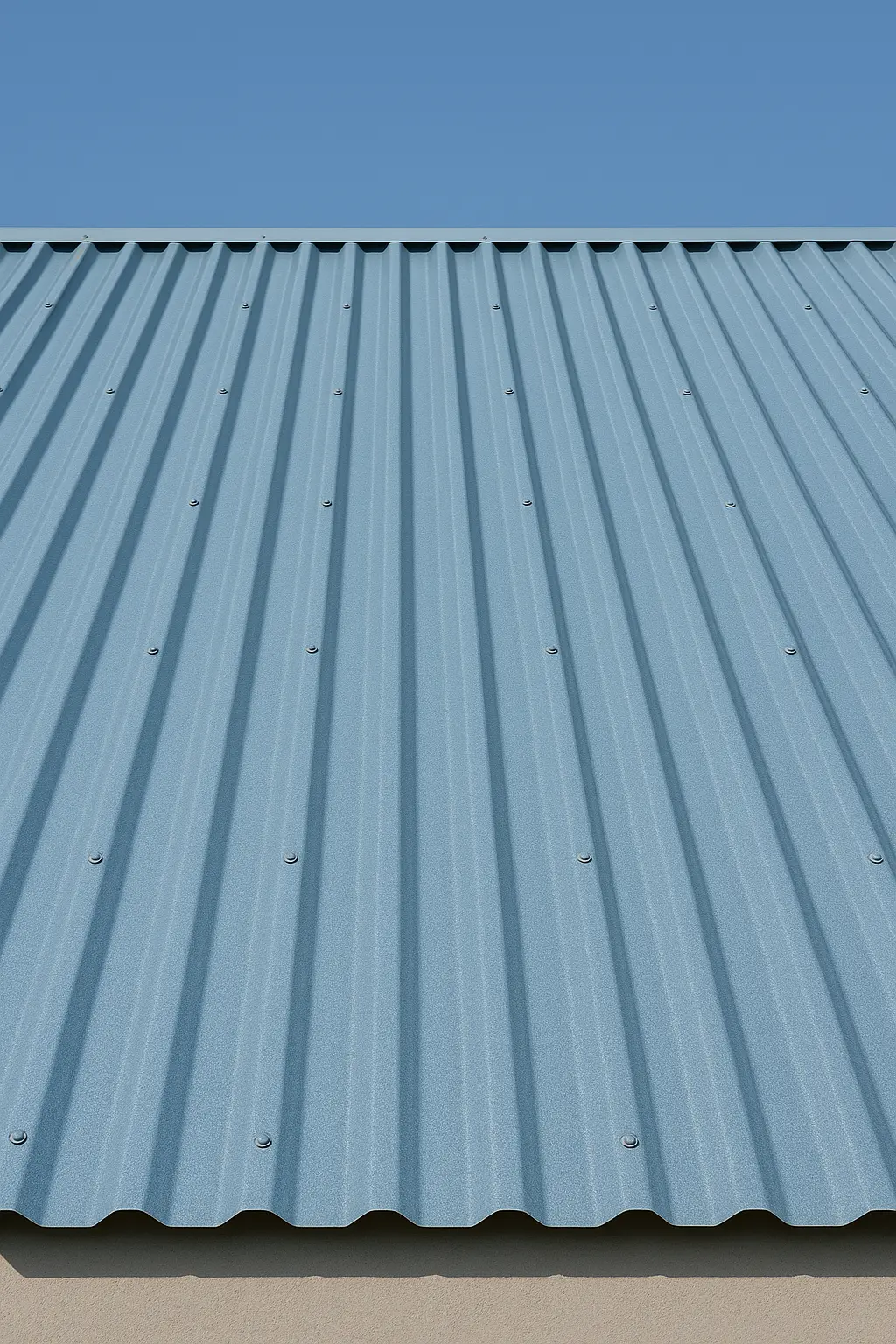
What are the Advantages of Using Roofing Sheets from Vishal colour roofs Limited?
High Durability
Made from premium-grade raw materials, Vishal colour roofs Limited roofing sheets offer long-lasting protection against weather, corrosion, and wear.
Superior Aesthetics
Available in a wide range of colors and profiles to match modern architectural designs while enhancing building appearance.
Thermal & Acoustic Insulation
Our sheets help reduce heat transmission and dampen external noise—ideal for warehouses, factories, and commercial spaces.
Leak-Proof Performance
Engineered with precision interlocking systems and coatings to ensure watertight sealing even under harsh monsoon conditions.
Low Maintenance
Smooth finishes and anti-fade coatings make our sheets easy to clean and maintain with minimal upkeep required over the years.
SHEET MANUFACTURING PROCESS FLOW – VISHAL COLOUR ROOFS PVT. LTD.
Raw Material Receiving (Coil Yard)
Coil Certificate Verification (Mill TC Check)
Coil Storage on Timber Saddles
Coil Loading on Decoiler
De-coiling → Pinch Rolls → Levelling
Roll Forming (Profile Forming)
Hydraulic Shearing / Cutting
Visual & Dimensional Inspection
Stacking & Edge Protection
Labelling & Storage
Labelling
Finished Goods Storage
Loading → Dispatch
Technical Process Description
Raw Material Receiving (Coil Yard)
Galvalume or Pre-painted steel coils of thickness 0.40–0.60 mm and width 1220–1400 mm are received from approved Indian manufacturers such as JSW, TATA, Apollo and AMNS. Upon arrival, coils are unloaded using an EOT crane placed in the designated coil yard. The coil identification tags are checked against the purchase order to ensure traceability and correct grade receipt.
Coil Certificate Verification (Mill TC Check)
The Quality Assurance department verifies the Mill Test Certificate (TC) accompanying each coil. The certificate is checked for parameters such as base metal grade, coating weight (AZ or Z), tensile strength, yield strength, and elongation. Random sampling is performed to verify coating thickness using an electronic coating gauge. Any non-conforming material is quarantined and reported for supplier intimation.
Coil Storage on Timber Saddles
Verified coils are stored horizontally on timber saddles to prevent direct contact with the floor and avoid surface damage. Proper spacing is maintained between coils for safe handling and identification. Each coil is tagged with a coil number, grade, thickness, color, and supplier name for easy reference during production.
Coil Loading on De-coiler
The Selected coil is loaded onto the motorized de-coiler using an EOT crane. The coil mandrel is adjust to the core diameter to ensure secure gripping. The leading edge of the coil is fed into the entry guide section for further processing. Safety locks and alignment checks are done prior to machine operation.
De-coiling → Pinch Rolls → Levelling
During de-coiling, the sheet passes through pinch rolls that help maintain straightness and control tension. The sheet then enters the leveller unit where minor coil set or waviness is removed to ensure flatness. This process provides a uniform feed to the roll forming section, improving the consistency of the finished profile.
Roll Forming (Profile Forming)
The leveled sheet is continuously passed through a series of roll forming stations, each progressively shaping the sheet into the required roofing or cladding profile. The rollers are made of high-grade steel and are precision machined to maintain consistent dimensional accuracy. Regular calibration ensures uniform crest height, pitch, and width across all sheets.
Hydraulic Shearing / Cutting
After the profile is formed, the sheet reaches the hydraulic shear where it is cut to the required ordered lengths. The length is pre-set in the control panel and maintained within a tolerance of ±5 mm. The hydraulic shear operates in synchronization with the line speed to achieve burr-free and straight cuts.
Visual & Dimensional Inspection
Each cut sheet is visual inspected for surface defects, paint damages, or coating scratches. Dimensional checks such as overall width, crest height, and pitch are carried out using calibrated measuring tools. Any non-conforming sheet is segregated and recorded for rework or rejection as per quality procedures.
Stacking & Edge Protection
Accepted sheets are stacked carefully on wooden battens to avoid direct contact with the ground.. The stacking is done as per length and profile type for easy traceability during dispatch.
Labelling
Labels are affixed on each bundle indicating order number, sheet type, color, length and quantity. The labelling ensures easy identification at the customer’s end and during internal storage.
Finished Goods Storage
Packed and labelled bundles are transferred to the finished goods area. Bundles are arranged systematically as per dispatch priority. Proper storage space is maintained to avoid overlap or bending of sheets. The storage area is covered and ventilated to minimize condensation and corrosion risk.
Loading → Dispatch
Based on the dispatch plan, bundles are loaded onto trucks using an EOT crane & Hydra. Wooden spacers are placed between bundles to prevent surface abrasion. Tarpaulin covering is provided for weather protection during transit. Final dispatch records include vehicle number, customer name, destination, and loading time for complete traceability.
