Roofing sheets are widely used in factories, warehouses, industrial sheds, commercial buildings, and pre-engineered structures because they offer efficient coverage, relatively quick installation, and dependable structural performance. However, industrial roofs remain exposed to rain, heat, dust, moisture, wind, pollutants, and regular site activity, so problems can develop over time.
Common issues include leakage, corrosion, loose fasteners, coating damage, water accumulation, and sheet deformation. These problems are not always caused by the roofing material itself. Installation quality, drainage, fasteners, roof penetrations, environmental exposure, and maintenance practices can all influence how a roofing system performs.
Understanding the most common roofing sheet problems can help factory owners, warehouse operators, contractors, and facility teams identify warning signs early and take appropriate preventive action.
This guide covers the most frequent problems affecting industrial roofing sheets, why they occur, and how their risk can be reduced.
Why Do Roofing Sheet Problems Develop?
An industrial roof is a complete system rather than a collection of metal sheets. Roofing profiles work together with fasteners, washers, flashings, sealants, ridge caps, gutters, drainage systems, purlins, and roof penetrations.
If one component is incorrectly installed or deteriorates, the performance of another part of the roof may be affected.
For example, a high-quality colour coated roofing sheet may still develop leakage if the sealing washer around a fastener fails. Similarly, corrosion can occur on otherwise well-coated roofing when cut edges are repeatedly exposed to moisture or metal debris is left on the roof.
Material specification, installation workmanship, protective coatings, environmental conditions, and timely inspection therefore all contribute to long-term roof performance.
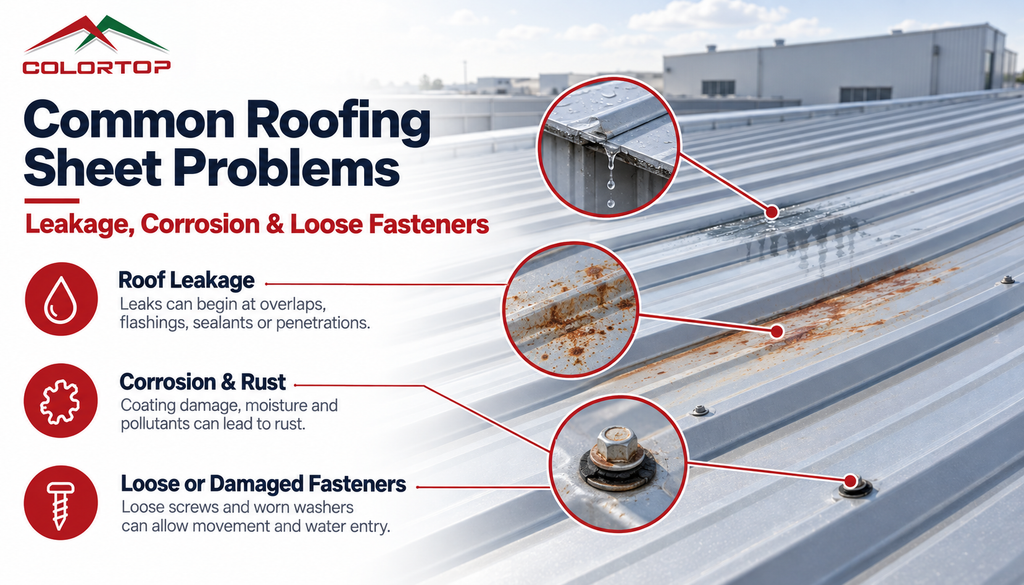
1. Roof Leakage
Leakage is one of the most noticeable roofing problems because water can quickly affect activities inside a factory or warehouse.
However, the location of water inside the building does not always identify the exact source of the leak. Water can travel along roofing members before becoming visible internally.
Potential leakage points include loose fasteners, deteriorated washers, incorrect sheet overlaps, failed sealants, damaged flashings, ridge details, and roof penetrations.
Preventing leakage starts with correct installation. Sheets should be fixed with appropriate overlap, fasteners, flashings, and sealing details according to the roofing system.
Periodic roof inspection is equally important. A loose screw or deteriorating sealant is generally easier to address before repeated rainwater exposure turns it into a recurring problem.
Drainage should also be kept clear because blocked gutters or standing water can increase pressure on vulnerable roof details.
2. Corrosion and Rust
Corrosion is another common concern in steel roofing systems.
Galvanized, galvalume, and colour coated metal roofing sheets use protective coatings designed to reduce direct exposure of the underlying steel to moisture and contaminants. However, these coatings can become damaged during transportation, cutting, installation, repair work, or uncontrolled roof access.
Cut edges, drilled holes, fastener locations, and areas where water or debris accumulates deserve particular attention.
The environment surrounding the building also matters. A standard storage warehouse may face mainly rain, dust, and temperature changes, while some manufacturing facilities may generate vapours, chemicals, high humidity, or industrial pollutants.
Corrosion risk can be reduced by selecting a suitable roofing and coating specification, protecting the surface during installation, maintaining drainage, removing metal filings, and attending to localized coating damage before deterioration spreads.
3. Loose or Damaged Fasteners
Fasteners secure roofing sheets to the supporting structure and help maintain weather resistance at fixing points.
They can develop problems when screws become loose, washers deteriorate, fasteners corrode, or installation is incorrect. Over-tightening can also cause trouble by excessively compressing a washer or deforming the roofing sheet.
A loose fastener may allow sheet movement during wind or thermal expansion. A damaged sealing washer may also create a pathway for moisture.
During inspection, fasteners should be checked for security, alignment, corrosion, washer condition, and visible movement around the fixing point.
Replacement components should be compatible with the existing roof rather than selected only because they are readily available.
4. Damage to Protective Coatings
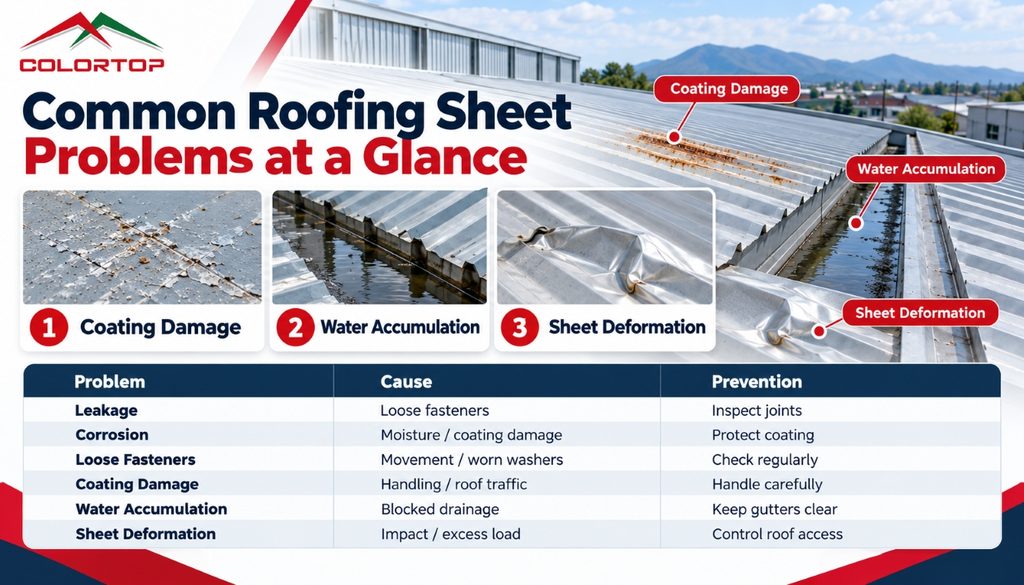
The protective finish of a color coated roofing sheet plays an important role in both appearance and corrosion resistance.
Damage can occur when sheets are dragged during unloading, cut with unsuitable tools, walked on carelessly, scratched by equipment, or affected during later rooftop work.
Solar-panel installation, HVAC servicing, ducting work, and other modifications can increase roof traffic and create new opportunities for coating damage.
Sheets should therefore be handled carefully from delivery through installation and subsequent maintenance.
When localized coating damage is found, the affected area should be assessed and, where appropriate, repaired using a method compatible with the roofing material and coating system.
Common Roofing Sheet Problems at a Glance
| Roofing Problem | Common Causes | Preventive Approach |
|---|---|---|
| Leakage | Loose fasteners, failed sealants, poor flashing | Inspect joints, penetrations and fixing points |
| Corrosion | Coating damage, moisture, pollutants | Protect coatings and maintain drainage |
| Loose fasteners | Movement, poor installation, damaged washers | Inspect fasteners periodically |
| Coating damage | Handling, cutting, uncontrolled roof traffic | Use careful handling and compatible repairs |
| Water accumulation | Blocked gutters, poor drainage | Keep drainage routes clear |
| Sheet deformation | Impact, improper walking, excessive loading | Control roof access and loading |
| Joint failure | Movement, incorrect overlap, sealant deterioration | Inspect overlaps and sealing details |
| Debris buildup | Dust, leaves, drilling waste | Maintain regular roof housekeeping |
5. Water Accumulation and Poor Drainage
A well-designed roofing system should move rainwater efficiently toward gutters, outlets, and downpipes.
When gutters become blocked or drainage routes are obstructed, water may remain on or around parts of the roof longer than intended.
Persistent moisture can affect sheet edges, joints, fasteners, flashings, and areas where protective coatings are already damaged.
Dust, leaves, packaging material, bird nesting material, and construction debris can all obstruct drainage.
Gutters and downpipes should therefore be included in periodic inspections. If water repeatedly collects in one location even after the drainage path has been cleaned, the roof geometry or drainage design may require additional evaluation.
6. Roofing Sheet Deformation
Roofing sheets can become dented or deformed because of impact, poor handling, excessive loading, or inappropriate roof access.
Industrial roofs may face higher risk during repair work or equipment installation when workers, tools, and materials are temporarily placed on the roof.
Severe deformation can affect sheet alignment, overlaps, drainage, and appearance. In some cases, it may also indicate that the roof has been subjected to a load or impact outside its intended use.
Roof access should therefore be controlled, and workers should understand appropriate walking routes and loading limitations.
If a sheet becomes visibly distorted, it should be inspected to determine whether the issue is only cosmetic or affects roof performance.
7. Problems Around Roof Penetrations
Factories and warehouses frequently contain numerous roof penetrations, including exhaust ducts, HVAC systems, pipes, skylights, ventilation units, cable entries, and solar mounting systems.
Every penetration creates a junction where roofing sheets, flashing, sealants, and another component meet. This makes such locations more vulnerable to leakage when detailing is poor or sealing materials deteriorate.
Problems can also appear after later modifications. New equipment may be installed without fully considering existing drainage patterns or roofing details.
Roof penetrations should therefore be properly planned, flashed, and sealed. They should also receive additional attention during periodic inspection, especially after new rooftop systems are installed.
8. Debris Buildup
Factory and warehouse roofs can collect dust, leaves, packaging materials, construction waste, and industrial residue.
Metal filings left after drilling or cutting are particularly undesirable because the small fragments can rust and stain otherwise undamaged coated sheets.
Debris can also trap moisture or obstruct gutters and drainage channels.
Roof housekeeping should therefore form part of routine maintenance. After installation, repair, solar work, or other rooftop activity, loose materials and metal fragments should be removed before the work is considered complete.
9. Incorrect Roofing Repairs
A poor repair can sometimes create additional problems.
For example, repeatedly applying sealant to a visible leak without locating the actual source may only provide temporary relief. Using unsuitable fasteners, incompatible repair materials, or painting directly over active corrosion can also reduce the effectiveness of repairs.
The first step should be identifying the underlying cause.
If the same issue returns after several localized repairs, a broader inspection may be required to determine whether another roofing component, drainage condition, or structural issue is contributing to the problem.
Repair or Replace? How to Decide
Not every damaged roofing sheet needs to be replaced.
Localized defects are often different from widespread deterioration.
| Roof Condition | Local Repair May Be Suitable | Wider Assessment May Be Needed |
|---|---|---|
| Minor coating scratch | Yes | Usually no |
| Individual loose fastener | Yes | Usually no |
| Single localized leak | Often | If it repeatedly returns |
| Small corrosion area | Sometimes | If corrosion is spreading |
| Damaged flashing | Often | If several locations are affected |
| Extensive corrosion | Limited | Yes |
| Severe sheet deformation | Limited | Yes |
| Multiple recurring leaks | Limited | Yes |
| Widespread coating failure | Limited | Yes |
A small coating defect or individual loose fastener does not automatically justify complete roof replacement.
On the other hand, repeatedly repairing a roofing system experiencing widespread corrosion, extensive coating failure, or multiple leaks may not address the larger problem.
The extent and cause of deterioration should therefore guide the decision.
How to Prevent Roofing Problems Before They Start
Preventive action is generally more effective than waiting for visible damage to become serious.
Industrial roofs should be inspected periodically and after severe weather, extensive roof access, or installation of rooftop equipment. Fasteners, joints, flashings, penetrations, gutters, and drainage routes deserve regular attention.
Roofing materials should also be selected according to actual building conditions. A warehouse in a relatively mild environment may have different roofing requirements from a manufacturing plant exposed to moisture, chemicals, or industrial emissions.
When selecting metal roofing sheets in India, buyers should consider the base material, sheet profile, thickness, protective coating, environmental exposure, supporting structure, installation requirements, and manufacturing quality.
Price should form part of the decision, but not the entire decision.
For project-specific requirements, buyers can explore the roofing sheet solutions from Vishal Colour Roofs Limited.
Frequently Asked Questions
What are the most common roofing sheet problems?
Leakage, corrosion, loose fasteners, damaged coatings, blocked drainage, sheet deformation, and problems around roof penetrations are among the common issues found in industrial roofing systems.
Why do metal roofing sheets start leaking?
Leaks may develop because of loose or damaged fasteners, failed washers, deteriorated sealants, incorrect overlaps, damaged flashing, poorly sealed roof penetrations, or drainage problems.
How can corrosion on roofing sheets be prevented?
Corrosion risk can be reduced by selecting an appropriate coating, protecting the surface during installation, maintaining drainage, removing metal debris, and addressing localized coating damage early.
Can loose roofing screws cause serious problems?
Loose fasteners can allow roofing sheets to move and may reduce sealing around fixing points. They should therefore be inspected and repaired or replaced where necessary.
Can damaged roofing sheets be repaired?
Localized damage may often be repairable depending on its severity and cause. Widespread corrosion, severe deformation, extensive coating failure, or recurring leaks may require broader assessment.
How can industrial roofing problems be detected early?
Periodic inspection of roofing surfaces, fasteners, flashings, penetrations, joints, coatings, gutters, and drainage can help identify developing issues before they become more serious.
Conclusion
Roofing sheet problems often begin with relatively small issues such as a loose fastener, blocked gutter, damaged coating, or poorly sealed penetration. If ignored, these localized defects may contribute to leakage, corrosion, or wider deterioration.
Factories and warehouses can reduce these risks through correct material selection, quality installation, clear drainage, controlled roof access, and timely inspection.
When a problem does occur, identifying its cause is more important than repeatedly treating only the visible symptom.
Vishal Colour Roofs Limited provides roofing sheets and related solutions for factories, warehouses, industrial sheds, commercial buildings, and pre-engineered structures. Buyers can review the available roofing sheet range to select specifications according to their building and environmental requirements.