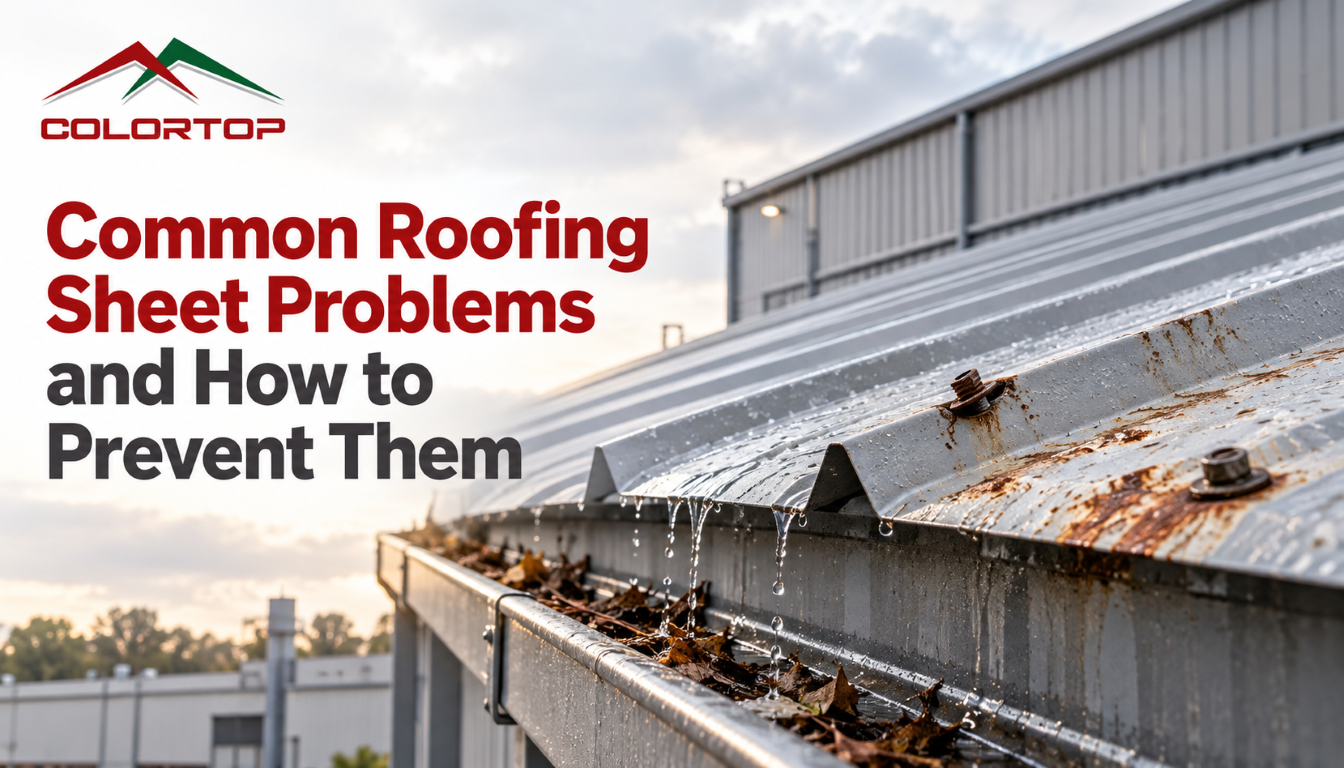
Roofing sheets used in factories and warehouses cover large areas and are continuously exposed to heat, rain, dust, moisture, industrial pollutants, and changing weather conditions. Over time, even a well-installed roof can develop issues such as loose fasteners, coating damage, blocked drainage, corrosion, or localized leakage.
Regular roofing sheet maintenance helps identify these problems before they become more serious. It also helps maintain roof performance, protect the building interior, and reduce the likelihood of unexpected repair work.
For factory owners, warehouse operators, facility teams, and industrial building managers, roof maintenance should not begin only after a leak appears. Periodic inspection, controlled cleaning, drainage checks, and early attention to minor damage can help the roofing system continue performing effectively.
This guide explains how to maintain industrial roofing sheets in factories and warehouses, what areas should be checked, how to reduce corrosion risk, and when repair or replacement may need to be considered.
Why Roofing Sheet Maintenance Matters in Factories and Warehouses
Factory and warehouse roofs are often significantly larger than residential or small commercial roofs. Because of their size, a problem in one area may remain unnoticed for some time before it begins affecting the interior of the building.
A loose fastener, damaged flashing, blocked gutter, or small coating defect may appear minor initially. If left unattended, however, it can contribute to water entry, corrosion, sheet movement, or repeated leakage.
Roof condition can also affect activities inside the building. Water ingress near machinery, electrical equipment, stored goods, production areas, or raw materials may interrupt operations and create additional repair costs.
Regular maintenance therefore helps protect not only the roofing sheet itself but also the overall industrial building.
For more information on factors that influence service life, refer to How Long Do Roofing Sheets Last? Lifespan Guide.
How Often Should Industrial Roofing Sheets Be Inspected?
There is no single inspection schedule that is suitable for every factory or warehouse. Inspection frequency should depend on the condition of the roof, local environment, building use, age of the roofing system, previous repair history, and the amount of rooftop equipment.
A relatively new warehouse in a low-exposure environment may require a different inspection approach from an older factory exposed to dust, fumes, moisture, or heavy industrial activity.
Additional inspection is particularly useful after severe rain, storms, repair work, solar-panel installation, HVAC work, exhaust installation, or any activity that requires regular roof access.
Visible signs such as internal water stains, loose sheets, damaged flashing, or recurring leakage should also trigger an inspection rather than waiting for the next planned maintenance cycle.
The main objective is to identify problems while they are still localized and manageable.
What Should Be Checked During a Roof Inspection?
A proper industrial roof inspection should cover the complete roofing system rather than only the visible sheet surface.
Important areas to check include:
- Roofing sheet surface: Look for scratches, dents, corrosion, coating damage, deformation, discoloration, and damage around cut edges.
- Fasteners and washers: Check for loose, missing, damaged, or corroded fasteners and deteriorated sealing washers.
- Sheet overlaps and joints: Inspect gaps, movement, loosened overlaps, and signs of water entry.
- Ridge caps and flashings: Review ridge areas, roof edges, side flashings, wall junctions, and penetrations.
- Gutters and drainage: Look for leaves, dust, debris, damaged gutters, blocked downpipes, and standing water.
Small defects should be assessed in context. A minor scratch does not automatically indicate a serious roof failure, but exposed steel or repeated moisture contact should not be ignored.
Industrial Roof Inspection Checklist
| Area to Inspect | What to Look For | Why It Matters |
|---|---|---|
| Roofing sheets | Scratches, dents, corrosion, coating failure | Helps identify surface deterioration |
| Fasteners | Loose, missing, or corroded screws | Reduces risk of sheet movement and leakage |
| Washers | Cracking, damage, or displacement | Helps maintain sealing around fixing points |
| Sheet overlaps | Gaps, movement, damaged sealant | Important for weather resistance |
| Flashings | Loose joints, gaps, deformation | Protects roof transitions and edges |
| Gutters | Dust, leaves, metal debris, blockage | Supports proper roof drainage |
| Downpipes | Blockage or damage | Helps prevent water accumulation |
| Roof penetrations | Gaps, sealant failure, damaged flashing | Common areas for water ingress |
How to Clean Roofing Sheets Safely
Cleaning is an important part of both factory roofing and warehouse roofing maintenance, particularly where dust, leaves, industrial residue, or construction debris may accumulate.
Loose material should be removed from roofing surfaces, gutters, valleys, and drainage points. Areas around roof-mounted equipment also deserve attention because debris can collect around mounting systems, ducts, skylights, or service penetrations.
Cleaning methods should be compatible with the roofing material and protective coating. Abrasive tools, aggressive scraping, or unsuitable chemicals can damage paint layers or metallic coatings and may reduce long-term corrosion protection.
Metal particles left after drilling or cutting are another common issue. Small steel filings can rust and create staining on otherwise undamaged roofing sheets. These should be removed after installation or repair work.
Roof access should also be controlled carefully. Unnecessary walking on roofing sheets can cause dents, deformation, or coating damage, especially if workers step in unsupported locations.
For large factory and warehouse roofs, cleaning and access procedures should always follow appropriate site-safety requirements.
How to Prevent Corrosion on Factory and Warehouse Roofs
Corrosion is one of the main concerns in steel roofing systems, but its development depends on several conditions.
Protective coatings on colour coated roofing sheets, galvanized sheets, and galvalume roofing sheets help isolate the underlying steel from moisture and environmental exposure. Problems can arise when coatings are scratched, damaged, exposed to aggressive contaminants, or kept wet for extended periods.
One of the most effective preventive measures is protecting the coating during installation and maintenance. Localized coating damage should be examined and treated using a repair method that is compatible with the roofing system.
Drainage also matters. Water that remains trapped on roofing sheets, around flashings, or inside blocked gutters increases moisture exposure. Keeping gutters and downpipes clear helps reduce this risk.
Cut edges and areas around drilled holes deserve special attention because the base metal may be more exposed in these locations. Similarly, fasteners should be checked for corrosion or loss of sealing performance.
The building environment should also influence the maintenance approach. A warehouse may mainly face dust and rain, while a manufacturing facility may be exposed to fumes, vapours, chemicals, heat, or persistent moisture. Roofing systems in more aggressive environments may require closer inspection and more careful coating selection.
Fastener and Sealant Maintenance
Fasteners and sealants are relatively small components, but they have a major role in maintaining the weather resistance of an industrial roof.
Fasteners should remain secure and correctly aligned. Loose fasteners may allow sheet movement, while damaged sealing washers can increase the risk of water entering around fixing points.
Maintenance teams should avoid simply tightening every screw as much as possible. Excessive tightening can damage washers or deform the roofing sheet around the fastener.
Sealants should also be inspected around flashings, ridge areas, roof penetrations, joints, and other weather-sensitive locations. Cracked, separated, or deteriorated sealant can reduce protection against water entry.
Any replacement fasteners or sealants should be compatible with the existing roofing system rather than selected only on availability or price.
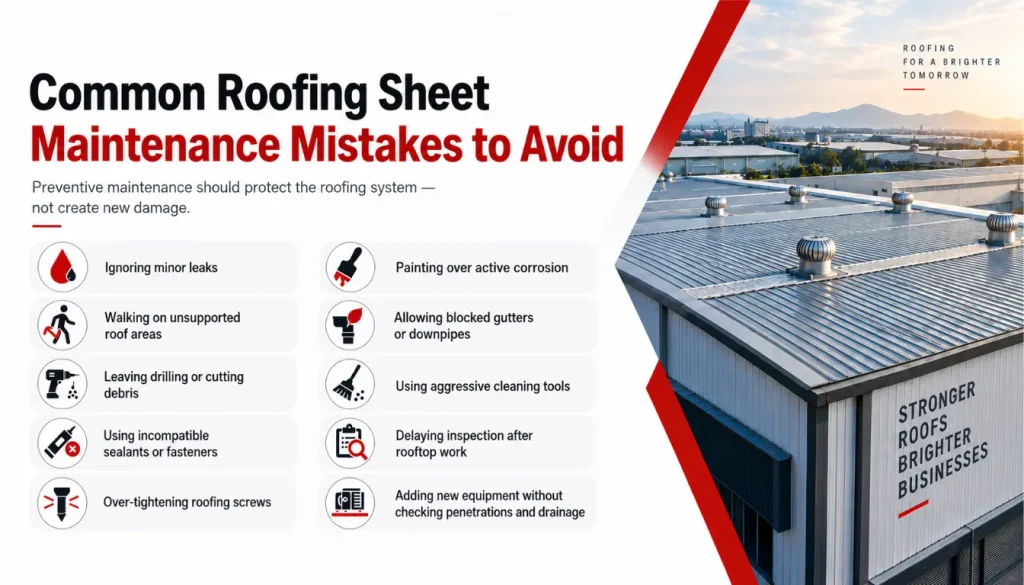
Common Roofing Sheet Maintenance Mistakes to Avoid
Even well-intentioned maintenance can create problems when incorrect methods are used.
Common mistakes include:
- Ignoring small leaks until they become recurring problems
- Walking carelessly on unsupported roof areas
- Leaving drilling or cutting debris on the roof
- Using incompatible sealants, fasteners, or repair materials
- Over-tightening roofing screws
- Applying paint directly over active corrosion without preparation
- Allowing gutters or downpipes to remain blocked
- Using aggressive cleaning tools that damage protective coatings
- Delaying inspection after rooftop installation or repair work
- Adding new equipment without checking how it affects roof penetrations and drainage
Preventive maintenance should protect the roofing system rather than introduce additional damage.
Repair or Replace? How to Decide
Not every roofing problem requires complete replacement.
Localized defects can often be inspected and repaired, while widespread deterioration may require a broader technical assessment.
| Roof Condition | Maintenance / Repair | Replacement Evaluation |
|---|---|---|
| Minor coating scratch | Usually possible | Usually not required |
| Loose fastener | Usually possible | Normally not required |
| Isolated leak | Often repairable | Depends on cause |
| Localized corrosion | May be repairable | Depends on severity |
| Damaged flashing | Often repairable | Usually not full-roof replacement |
| Widespread corrosion | Limited repair value | Should be evaluated |
| Severe sheet deformation | Limited | Often needs evaluation |
| Repeated leaks in multiple areas | Investigation required | May be necessary |
| Extensive coating breakdown | Limited | May require wider action |
The cause of the problem is just as important as its appearance. For example, a recurring leak from one poorly sealed penetration may require a localized repair, while leakage across several roof areas may indicate broader deterioration.
Maintenance Checklist for Factory and Warehouse Roofing
A simple maintenance checklist can make inspections more consistent and help facility teams track recurring problems.
Before closing an inspection, verify that:
- Roofing sheet surfaces have been checked for damage, corrosion, dents, and coating failure
- Fasteners and washers are secure and in good condition
- Sheet overlaps, ridge caps, and flashings have been inspected
- Gutters and downpipes are clear
- Debris has been removed from the roof
- Roof penetrations around ducts, skylights, solar systems, and HVAC units have been checked
- Areas of standing water have been identified
- Any localized coating damage has been recorded
- Repairs and observations have been documented for follow-up
Maintaining basic records of inspection dates, repair locations, and recurring issues can make future roof assessments more effective.
Special Areas That Need Extra Attention
Factories and warehouses often include rooftop elements that create additional maintenance requirements.
Solar-panel mounting areas should be reviewed because installation and servicing increase foot traffic and introduce mounting points and cable penetrations. Areas around brackets and penetrations should remain properly sealed and free from trapped debris.
Exhaust and ventilation systems may expose nearby roofing sheets to heat, moisture, or process-related contaminants. These areas may require closer visual inspection than open roof sections.
Skylights and HVAC units create additional junctions between roofing and other building components. Flashings, sealants, and drainage around these locations should remain in good condition.
Building extensions also deserve attention. Where an older roof meets a newer structure, changes in roof level, flashing details, drainage, or sheet profile can create vulnerable junctions.
In manufacturing facilities, areas exposed to industrial emissions or chemicals may show different deterioration patterns from the rest of the roof. Maintenance should therefore consider actual operating conditions rather than treating every part of the roof in the same way.
Why Professional Roof Inspection May Be Needed
Routine visual inspections can identify many common roofing issues, but some problems require technical assessment.
Professional inspection may be appropriate when leaks repeatedly return after repair, large areas show corrosion, several sheets appear loose, severe deformation is visible, drainage problems persist, or structural movement is suspected.
A technical inspection can help determine whether the source of the problem is the roofing sheet, fasteners, flashing, drainage, supporting structure, or another building component.
This is particularly important when repeated local repairs fail to solve the issue.
Structural concerns should be evaluated by suitably qualified professionals rather than treated as ordinary roof-maintenance problems.
Frequently Asked Questions
How often should factory roofing sheets be inspected?
Inspection frequency depends on roof condition, local environment, building use, age, and previous maintenance history. Additional inspections are advisable after severe weather, major rooftop work, or whenever signs of leakage or damage appear.
How should warehouse roofing sheets be cleaned?
Loose dust, leaves, and debris should be removed without using abrasive tools that could damage protective coatings. Gutters and drainage systems should also be kept clear, and cleaning methods should be suitable for the specific roofing material.
What causes corrosion on industrial roofing sheets?
Corrosion can be influenced by damaged coatings, prolonged moisture, industrial pollutants, cut edges, incompatible materials, poor drainage, and aggressive environmental exposure.
Can loose roofing screws cause leaks?
Yes. Loose or damaged fasteners can allow sheet movement or reduce sealing around fixing points, which may contribute to water entry.
Can damaged coating on roofing sheets be repaired?
Localized coating damage may be repairable depending on the type of roofing sheet and the extent of deterioration. Any repair system should be compatible with the original roofing material and coating.
When should factory or warehouse roofing sheets be replaced?
Replacement should be evaluated when deterioration becomes extensive, such as widespread corrosion, major deformation, recurring leaks across multiple areas, or large-scale coating failure. Localized damage does not automatically require complete roof replacement.
Conclusion
Maintaining roofing sheets in factories and warehouses requires more than responding to visible leaks. Regular inspection, safe cleaning, clear drainage, fastener checks, coating protection, and early attention to localized damage can all help support long-term roof performance.
Industrial roofs should also be assessed according to their operating environment. Solar systems, exhausts, HVAC equipment, skylights, industrial fumes, and building extensions can create areas that require additional attention.
When deterioration becomes widespread or repeated repairs fail to solve a problem, a broader professional assessment may be appropriate.
For industrial and commercial roofing requirements, Vishal Colour Roofs Limited provides roofing sheet solutions for factories, warehouses, industrial sheds, and pre-engineered building applications.