Walk onto any active construction site in India today, and you’ll quickly notice that choosing a roof isn’t as simple as ordering a bunch of corrugated metal panels. Whether you’re setting up a commercial warehouse in an industrial park, building a coastal manufacturing plant, or putting together a sleek sports complex, the roof sitting on top of your framework dictates how well your structure survives over the next thirty years.
Pick the wrong sheet profile or coating, and you’ll spend your monsoons fighting stubborn water leaks, peeling paint, and rust spots that eat through your steel. Pick the right material, and your building stays dry, thermally comfortable, and virtually maintenance-free. To help you navigate the options, Vishal Colour Roofs Limited breaks down the exact sheet profiles you should consider for your next project.
1. Understanding the Base Metal: Why Galvalume Leads the Pack
Before you even think about sheet profiles or color finishes, you need to look at the raw metallic coating protecting the base steel underneath. Traditional galvanizing relies entirely on zinc. While zinc protects steel well enough in mild weather, it wears down relatively quickly when exposed to heavy industrial pollution, chemical fumes, or salty ocean breeze.
This is where galvalume roofing sheets have completely taken over the commercial market. Galvalume uses a precise alloy coating made of roughly 55% aluminum, 43.4% zinc, and 1.6% silicon. The aluminum acts as an incredible barrier against atmospheric corrosion, while the zinc provides galvanic protection to exposed cut edges. This double-action defense gives Galvalume up to four times the lifespan of standard galvanized steel under harsh weather conditions. If your project sits in an area with aggressive rain, high humidity, or intense industrial exhaust, starting with a Galvalume base is non-negotiable.
2. Handling Complex Architectural Spans: The Role of Crimp Curves
Not every building roof is a simple flat slope. Modern architectural designs frequently call for curved ridges, arched spans, rounded eaves, and seamless transitions from the main roof deck down to vertical wall cladding. Trying to force standard straight sheets onto a curved steel framework creates massive problems, you end up with stressed joints, buckled metal, and gaping holes where rainwater easily sneaks inside.
To solve this structural headache, engineers rely on crimp curved roofing sheets. Then the panels are subjected to another cold rolling process in the factory that presses precise indents or crimps into the sheet at calculated intervals. This allows the metal panel to be smoothly bent into a custom radius without cracking the protective coating or buckling the steel profile. Using factory-crimped sheets gives your building a clean, modern aesthetic while completely eliminating the need for leaky horizontal joints at the roof ridge.
3. Color Coated Metal Sheets for Thermal Control and Esthetics
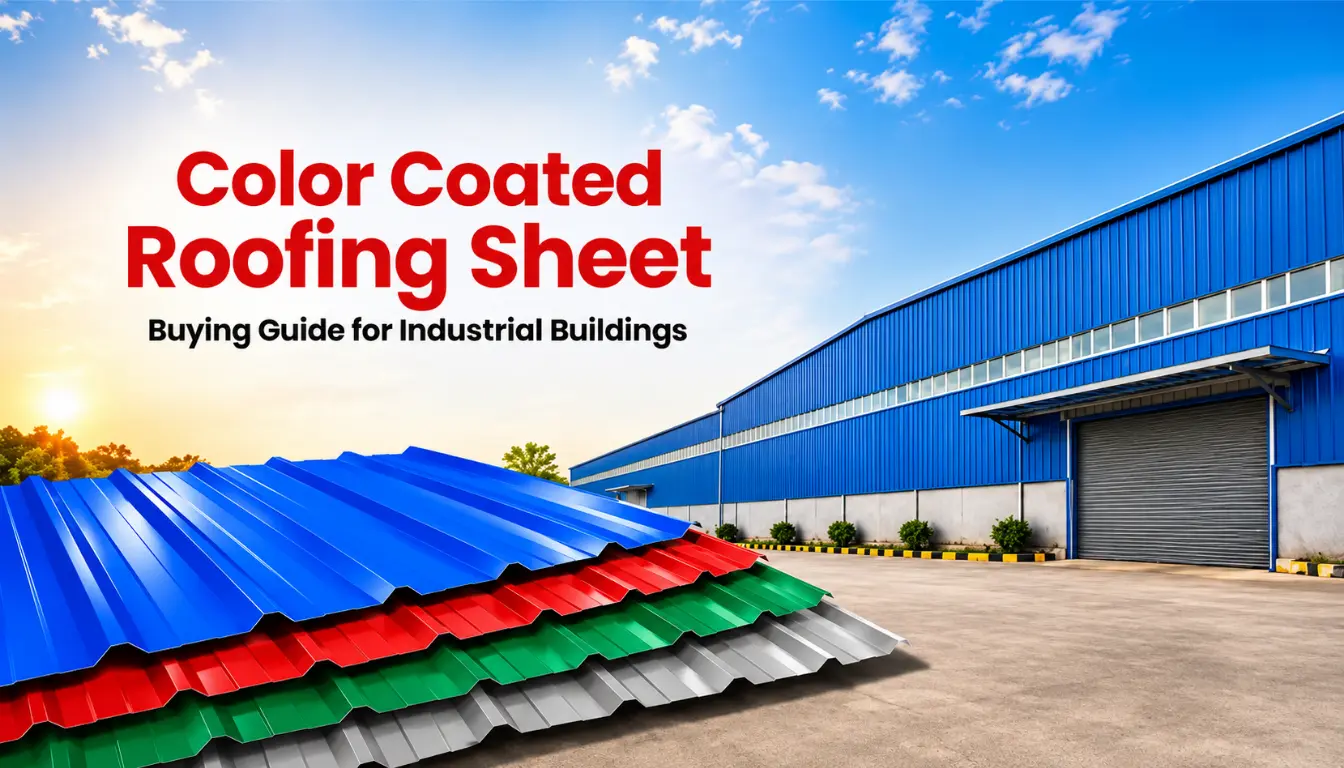
Color-coated metal panels are the way to go if you want to keep your facility looking sharp while cutting down on your monthly cooling bills. They’re not just painted after they’re made. They get an automated, multi-stage coil coating process right in the manufacturing facility. The steel is cleaned, chemically treated, primed, and baked with high-performance polymers like Regular Modified Polyester (RMP) or Silicon Modified Polyester (SMP).
Beyond looking professional, high-grade color-coated panels act as “cool roofs.” They reflect solar heat back into the atmosphere instead of absorbing it down into your work floor. When paired with proper under-roof insulation like rockwool or glasswool, color-coated sheets keep indoor temperatures comfortable and reduce the load on your HVAC systems during scorching summer months.
4. Matching the profiles of sheets to your specific needs of the project
These practical application rules will help you hone in on the exact material for your project by matching your type of construction.
- Heavy Industrial Plants & Chemical Units: Stick with high-thickness galvalume roofing sheets featuring specialized chemical-resistant paint coatings to withstand internal fumes and external weather.
- Warehouses & Logistics Hubs – Choose the best metal roofing sheets and high rib trapezoidal metal profiles in India. High ribs provide superior water-carrying capacity during heavy cloudbursts, preventing water accumulation on low-slope roofs.
- Sports Arenas, Canopies, & Architectural Sheds: Use crimp curved roofing sheets to achieve smooth, continuous arched spans that look great and shed water effortlessly.
- Coastal Facilities: Choose thick-coated alloy sheets with specialized anti-corrosive primers to block salt spray from attacking the raw steel.
5. The Importance of Certified Factory Roll-Forming
You can buy the best raw steel in the world, but if the roll-forming process is done on worn-out local machinery, your roof will fail. Poorly rolled panels feature uneven rib heights and loose overlapping joints that fail to seal properly when installed on-site.
Always source your panels directly from an established manufacturer running automated, high-precision roll-forming lines. Factory-controlled production guarantees that every panel profile matches exact millimeter tolerances, ensuring an airtight, watertight interlock across your entire roof structure.
Bottom Line
The key to choosing the correct roofing panel is matching your local environment with the correct alloy coating, profile shape and sheet thickness. Don’t compromise on raw material quality just to save a few rupees per square foot upfront—replacing a failed roof down the line costs exponentially more than building it right the first time.
With over twenty-five years of manufacturing experience, certified ISO standards, and precision production lines, Vishal Colour Roofs Limited delivers tailored roofing solutions designed to protect your project for decades.
FAQs
Q1: What is the main difference between Galvalume and standard Galvanized sheets?
Ans: Galvanized steel uses a 100% zinc coating, whereas Galvalume uses a combination of 55% aluminum and 43.4% zinc. The addition of aluminum gives galvalume roofing sheets significantly better resistance against rust and heat, making them last up to four times longer in aggressive weather.
Q2: When should I use crimp curved roofing sheets instead of straight panels?
Ans: You should use crimp curved roofing sheets whenever your building design features curved ridges, rounded eaves, arched structures, or barrel vaults. Trying to bend straight panels manually causes buckling and leaks, whereas factory-crimped sheets curve smoothly without losing structural strength.
Q3: How do high-rib roofing sheet profiles help during heavy monsoon rains?
Ans: High-rib trapezoidal profiles create deep channels that increase the water-discharge capacity of your roof. When heavy rains hit, these high ribs guide large volumes of water off the building quickly, preventing water accumulation and overflows at side overlaps.
Q4: How do I know I am getting the best metal roofing sheets in India for my facility?
Ans: Check the technical specifications of the raw steel coil, specifically the base metal thickness (BMT), coating mass (AZ150 for Galvalume), and paint finish (RMP/SMP/PVDF). Sourcing directly from an ISO-certified manufacturer like Vishal Colour Roofs Limited ensures you get genuine material that meets exact structural standards.