Pre-engineered buildings are widely used for warehouses, factories, industrial sheds, logistics facilities, workshops and large commercial structures because they offer efficient structural design, faster execution and flexibility for future expansion.
While the primary structural system of a PEB includes columns and rafters, secondary framing members are equally important for supporting the roof and wall systems. Among these components, Z & C purlins play a major role in providing support to roofing sheets, wall cladding and other building-envelope elements.
Z and C purlins are cold-formed steel sections designed to provide structural support while keeping the overall framing relatively lightweight. Their strength-to-weight ratio, ease of installation, customization options and suitability for industrial applications make them a common choice in modern steel construction.
For businesses comparing z purlin manufacturers in India, understanding the difference between Z and C purlins, their applications and the factors that influence their selection can help in making better project decisions.
What Are Z & C Purlins?
Z & C purlins are cold-formed steel sections named according to the shape of their cross-section.
A Z purlin has a profile similar to the letter Z, while a C purlin has a C-shaped cross-section.
These sections are typically installed between the primary structural frames of a steel building and act as secondary framing members. Their main function is to support roof sheets, wall cladding and other lightweight building components while transferring loads to the main structural frame.
Purlins can be manufactured in different sizes, lengths and thicknesses depending on structural requirements. Hole positions and connection details can also be customized according to approved engineering drawings.
Vishal Colour Roofs Limited manufactures Z & C purlins for industrial and PEB applications in project-specific sizes and specifications.
For detailed product information, visit the Z & C Purlin page of Vishal Colour Roofs Limited.
What Is the Role of Purlins in a PEB Structure?
A pre-engineered building usually consists of primary framing, secondary framing, roofing, wall cladding, bracing systems and accessories.
The primary framing includes major load-bearing members such as columns and rafters. Purlins form part of the secondary structural system and help connect the roof system to the main frame.
Their main functions include:
- Supporting roofing sheets
- Transferring roof loads to primary structural members
- Providing fixing points for roof panels
- Maintaining spacing and alignment between structural frames
- Supporting wall cladding when similar sections are used as girts
- Improving stability of the building envelope
- Helping distribute loads across the roof structure
The size, thickness and spacing of a purlins roof system should always be determined through structural design rather than selected only on the basis of material cost.
What Are Z Purlins?
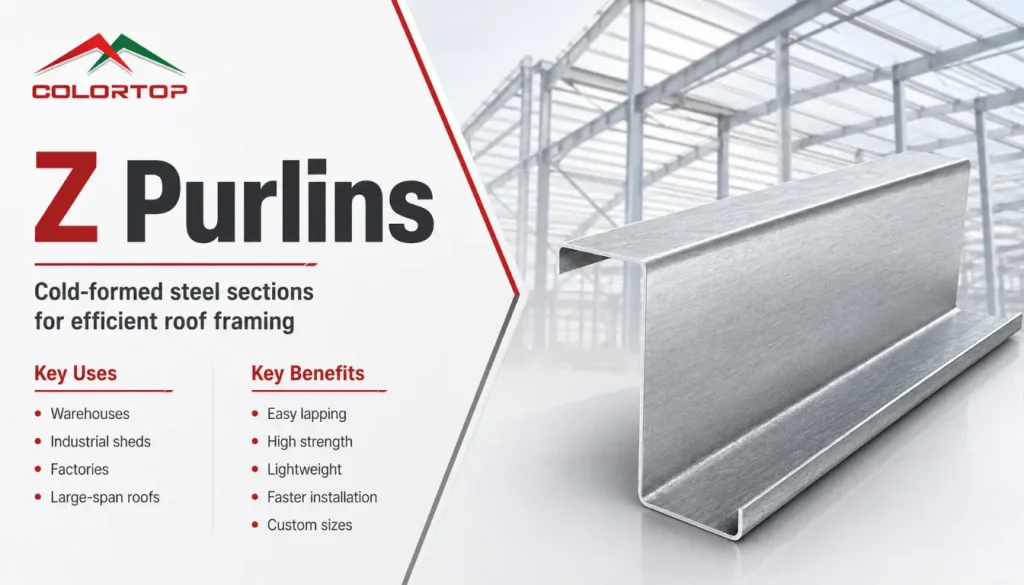
Z purlins are cold-formed steel members manufactured in a Z-shaped profile.
One of the biggest advantages of Z purlins is their ability to overlap or lap at structural supports. This makes them suitable for continuous framing arrangements, especially in buildings with multiple bays.
Because adjoining sections can overlap, Z purlins for roof systems are widely used in large industrial and commercial structures where long roof runs are required.
Common Applications of Z Purlins
Z purlins are commonly used in:
- Warehouses
- Manufacturing plants
- Industrial sheds
- Workshops
- Logistics centres
- Storage buildings
- Railway structures
- Commercial facilities
- Agricultural buildings
- Large-span roofing systems
Their profile makes them particularly suitable for multi-bay buildings and continuous roof framing.
Key Advantages of Z Purlins
Efficient lapping at supports
The Z-shaped geometry allows adjacent sections to overlap, supporting continuity between structural bays.
High strength-to-weight ratio
Cold-formed steel sections can provide efficient structural support without adding excessive weight.
Suitable for long roof systems
Z purlins are frequently used in long-span and multi-bay industrial buildings.
Easy handling
Their relatively lightweight construction makes them easier to transport, lift and position during installation.
Custom manufacturing
They can be manufactured in specific section sizes, lengths, thicknesses and punching patterns according to project requirements.
What Are C Purlins?
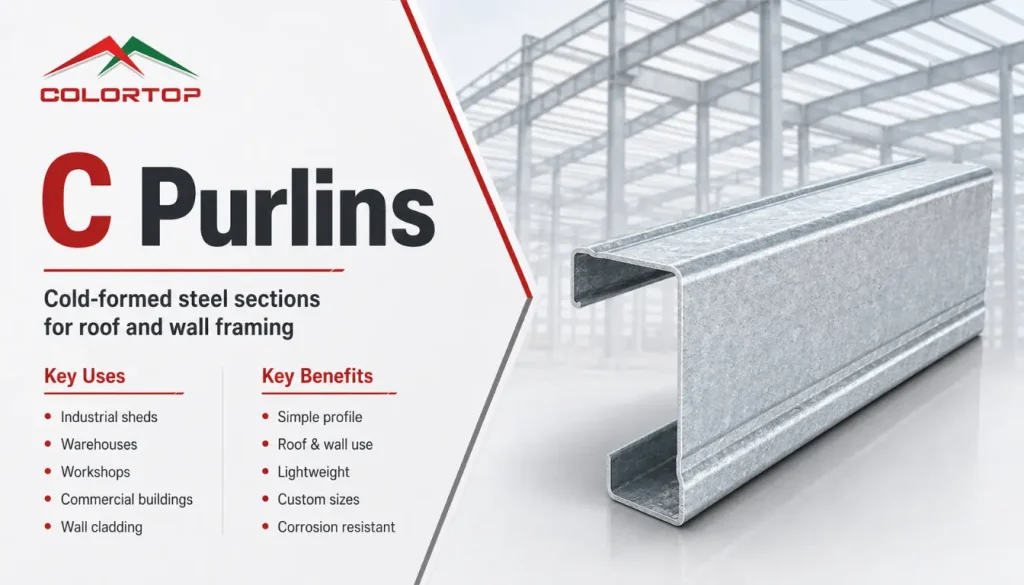
C purlins are cold-formed steel sections shaped like the letter C.
They are widely used in secondary framing systems for both roof and wall applications. Their simple profile makes them suitable for individual structural members where continuous lapping is not required.
C-shaped sections are also commonly used as wall girts for supporting wall cladding.
Common Applications of C Purlins
C purlins are used in:
- Industrial sheds
- Warehouses
- Workshops
- Commercial buildings
- Wall-cladding support systems
- Storage facilities
- Agricultural structures
- Smaller steel buildings
- PEB secondary framing
Key Advantages of C Purlins
Simple structural profile
The C-shaped section is straightforward and suitable for various secondary framing applications.
Suitable for roof and wall systems
C purlins can support both roofing and wall-cladding systems depending on structural requirements.
Lightweight construction
Their comparatively low weight can simplify site handling and erection.
Custom sizing
They can be manufactured according to specific lengths, dimensions, thicknesses and connection details.
Corrosion resistance
Galvanized steel options offer improved resistance against corrosion under suitable environmental conditions.
Z Purlin vs C Purlin: Key Differences
Although both Z and C purlins perform similar secondary structural functions, their geometry and typical applications differ.
| Factor | Z Purlin | C Purlin |
|---|---|---|
| Cross-section | Z-shaped | C-shaped |
| Typical use | Roof framing | Roof and wall framing |
| Lapping | Suitable for overlapping at supports | Usually used as individual sections |
| Multi-bay structures | Commonly preferred | Project-dependent |
| Wall girts | Less common | Common application |
| Long roof runs | Well suited | Depends on structural design |
| Installation | Lightweight | Lightweight |
| Custom sizes | Available | Available |
Neither type is automatically better.
The right choice depends on the building span, bay spacing, roof profile, connection design, structural loads, environmental conditions and engineering requirements.
Purlins vs Girts: What Is the Difference?
Purlins and girts are both secondary steel members, but their location and purpose differ.
Purlins are generally installed horizontally along the roof and provide support to roofing sheets.
Girts are positioned along the walls and support wall-cladding sheets.
In many PEB projects, Z-shaped members are commonly used as roof purlins, while C-shaped sections are frequently used as wall girts.
However, the final arrangement must always follow the structural design and project-specific requirements.
Key Benefits of Z & C Purlins in PEB Structures
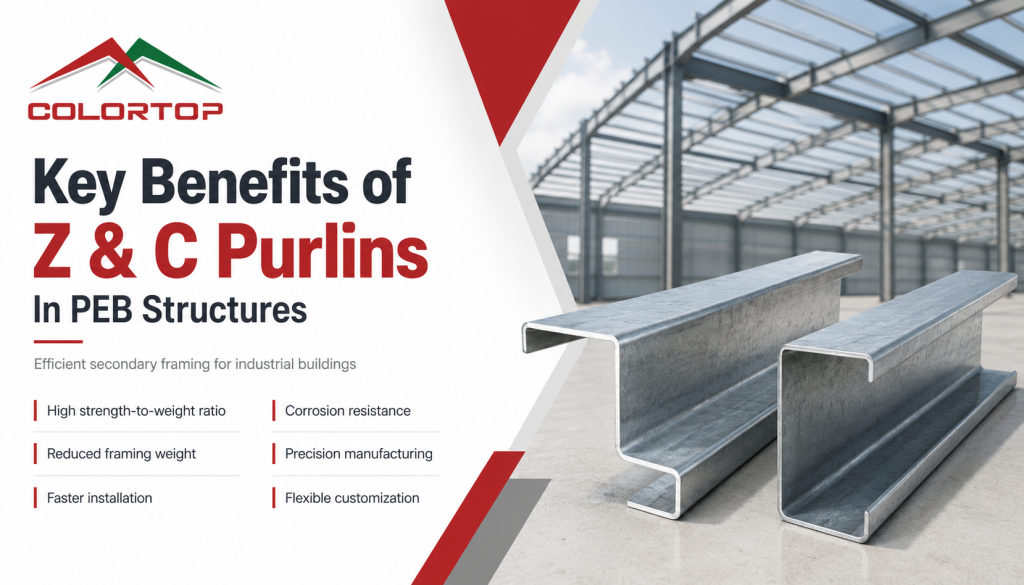
1. High Strength-to-Weight Ratio
Cold-formed steel purlins are designed to provide structural strength without requiring unnecessarily heavy sections.
This makes them suitable for projects where material efficiency and reduced structural weight are important.
2. Reduced Secondary Framing Weight
Compared with some traditional framing sections, properly designed purlins may help reduce the overall weight of the secondary steel structure.
A lighter structural system may also help simplify transportation, handling and erection.
However, the actual material saving depends on structural design, span, load conditions and section selection.
3. Faster Installation
Because Z & C purlins are relatively lightweight, they are easier to transport and position during site erection.
Accurately manufactured sections with pre-punched connection holes can also improve alignment and simplify installation.
This can help contribute to faster project execution.
4. Corrosion Resistance
Galvanized purlins provide a protective zinc coating that improves resistance to corrosion.
The appropriate coating specification should be selected based on humidity, industrial exposure, environmental conditions and the expected service life of the structure.
For aggressive environments, coating selection becomes especially important.
5. Precision Manufacturing
Modern purlins are produced using roll-forming equipment that shapes the steel into consistent Z or C profiles.
The sections can then be punched and cut according to approved project drawings.
Accurate dimensions and hole positions help reduce alignment problems during erection.
6. Flexible Customization
No two industrial projects are exactly the same.
Z & C purlins can therefore be customized based on:
- Section size
- Material thickness
- Length
- Hole pattern
- Connection requirements
- Galvanized coating specification
- Project drawings
This makes them adaptable for warehouses, factories, logistics facilities and other industrial structures.
Where Are Z & C Purlins Used?
Z and C purlins are used across a wide range of industrial and commercial construction projects.
Typical applications include:
- Pre-engineered buildings
- Warehouses
- Factory sheds
- Manufacturing facilities
- Logistics centres
- Workshops
- Commercial buildings
- Storage facilities
- Agricultural structures
- Railway infrastructure
- Large-span roofing systems
For projects using Z purlins for roof construction, the final purlin section and spacing should be coordinated with the roofing-sheet profile and structural design.
How Are Z & C Purlins Manufactured?
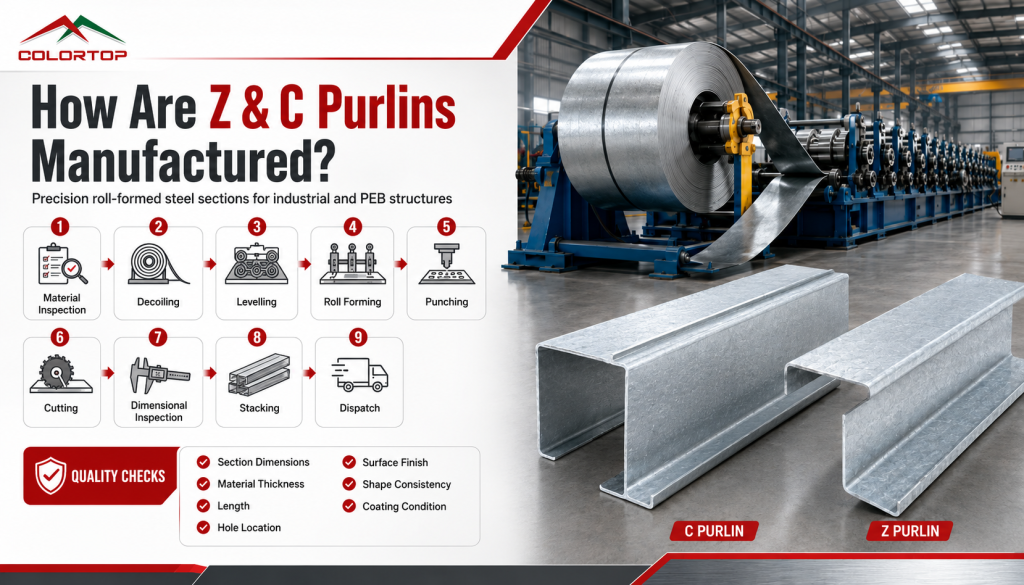
The manufacturing process generally begins with steel coils selected according to the required material specification.
The coil is fed into a roll-forming line, where it passes through multiple forming stages until the required Z or C profile is achieved.
Depending on the project drawing, holes can be punched at predetermined positions for structural connections.
The sections are then cut to the required length and inspected before dispatch.
A typical manufacturing process includes:
Material inspection → Decoiling → Levelling → Roll forming → Punching → Cutting → Dimensional inspection → Stacking → Dispatch
Quality checks are important for confirming:
- Section dimensions
- Material thickness
- Length
- Hole location
- Surface finish
- Shape consistency
- Coating condition
Consistent manufacturing helps ensure easier installation and better alignment at the construction site.
How to Choose the Right Purlin for Your Project
Selecting the right purlin should not be based only on the lowest quotation.
Several technical factors need to be evaluated.
Building Span
Building dimensions and bay spacing influence the required purlin section and spacing.
Longer or more demanding spans may require different structural configurations.
Structural Loads
The design should consider all applicable loads, including:
- Wind load
- Roof load
- Maintenance load
- Equipment load
- Solar-panel load, where applicable
- Service loads
Purlin Spacing
The distance between purlins affects both structural performance and roofing-sheet support.
The roof profile and allowable sheet span should therefore be considered during design.
Material Thickness
A thicker section is not automatically better.
The correct thickness should be determined through engineering calculations according to load requirements and span.
Environmental Conditions
Humidity, rainfall, industrial pollutants and exposure conditions can influence the required coating and material specification.
Connection Details
Hole patterns, bolts and structural connections should match approved drawings.
Incorrect connection details can create installation difficulties and affect structural performance.
Roofing System
The roofing-sheet profile, thickness and structural span capability should be coordinated with the purlin system.
Choosing a Z Purlin Supplier in Delhi NCR
For projects in Delhi NCR, Noida, Greater Noida and nearby industrial areas, choosing a reliable Z Purlin Supplier in Delhi NCR can make coordination easier for manufacturing, customization and delivery.
However, buyers should not select a supplier based only on location.
Important factors include:
- Manufacturing capability
- Material quality
- Dimensional accuracy
- Customization options
- Punching accuracy
- Quality-control procedures
- Ability to follow project drawings
- Delivery capability
- Technical coordination
- Experience with industrial and PEB projects
When comparing different z purlin manufacturers in India, buyers should evaluate the complete manufacturing and technical capability rather than relying only on price.
Vishal Colour Roofs Limited supplies Z & C purlins for industrial and PEB structures and offers customized options based on project requirements.
For product details, visit the Z & C Purlin page.
Related Sources
What is a Pre-Engineered Building? Complete Guide
Top 10 PEB Manufacturers in India (2026)
Types of Roofing Sheets in India: Complete Guide for Industrial & Commercial Buildings
PEB Buildings vs RCC Structures: Which Is Better for Industrial Projects in 2026?
How to Install Roofing Sheets: Step-by-Step Guide & Expert Tips
Conclusion
Z & C purlins are important secondary framing components in pre-engineered and steel-building systems. They provide reliable support for roofing and wall cladding while offering benefits such as high strength-to-weight ratio, lightweight construction, ease of installation, dimensional customization and corrosion-resistant options.
Z purlins are particularly suitable for continuous roof framing and multi-bay structures because they can overlap at supports, while C purlins are commonly used for both roofing and wall applications.
The correct profile, section size, thickness, spacing and coating should always be selected according to project specific structural requirements.
For customized Z & C purlins for warehouses, factories, industrial sheds and PEB projects, explore the Z & C Purlin range from Vishal Colour Roofs Limited
Frequently Asked Questions
What are Z & C purlins?
Z & C purlins are cold-formed steel sections used as secondary framing members in steel and pre-engineered buildings. They support roofing sheets, wall cladding and related structural components.
What are Z purlins used for?
Z purlins are mainly used as roof-supporting members in warehouses, factories, industrial sheds and large-span structures.
Are Z purlins suitable for roof structures?
Yes. Z purlins for roof systems are widely used because they can overlap at structural supports and work efficiently in continuous roof framing.
What is the difference between Z purlins and C purlins?
Z purlins have a Z-shaped profile and are commonly used in continuous roof framing. C purlins have a C-shaped profile and are widely used for both roofing support and wall-girt applications.
Can Z & C purlins be customized?
Yes. They can be manufactured in different lengths, thicknesses, section sizes and punching patterns according to structural drawings.
Which purlin is better for industrial buildings?
There is no single answer. The correct profile depends on span, loads, roof design, bay spacing, connection details and structural calculations.
How do I compare z purlin manufacturers in India?
Compare manufacturing capability, steel specifications, dimensional accuracy, customization, quality control, project experience and delivery support instead of selecting only on price.
Where can I find a Z Purlin Supplier in Delhi NCR?
Vishal Colour Roofs Limited provides Z & C purlins for industrial and PEB applications. Project-specific sizes and specifications can be reviewed through the company’s Z & C Purlin product page.