When you’re setting up a new factory or warehouse, you aren’t just looking at columns and beams. You’re looking at a massive financial commitment. A commitment that’s going to impact your business operations for the next thirty or forty years.
Down on the ground, the decision always boils down to two options. You either go with pre-engineered buildings (PEB) or you stick with conventional structural steel fabrication. Both will give you a solid, standing structure. But the way they get built, how fast they go up, and what they do to your bank account couldn’t be more different.
To make the right call, you have to look past the marketing brochures and see how these things actually perform on a real Indian construction site. As a long-standing steel structure manufacturer in India, Vishal Colour Roofs Limited is going to lay out the plain, unvarnished facts.
How the Steel Actually Gets Engineered
Let’s look at conventional steel sheds first. These use traditional, hot-rolled steel sections, your standard I-beams, heavy channels, and angles. The thing with these sections is that they are completely uniform. A beam is just as thick and heavy at its ends as it is right in the middle. Your local fabrication crew cuts, welds, and pieces them together, either in a workshop or right in the dirt on your site. Yes, it creates a heavy, rock-solid frame. But it also throws a lot of steel away. You end up buying and paying for thick, heavy steel in low-stress zones where that extra weight isn’t even doing any work.
PEB turns that whole approach upside down. Instead of using fixed, uniform shapes from a mill, PEB frames use custom, tapered profiles. We design them using specialized structural software. The steel is deep and thick only where the stress hits hardest. Then it thins out where the internal forces drop. This maximizes the efficiency of every gram of raw material. You get a much lighter framework, you save a lot on raw steel costs, and you don’t lose an ounce of strength or safety compliance.
The Battle of Construction Timelines
In industrial projects, time isn’t just money; it’s everything. Every week your site is delayed is a week you aren’t manufacturing or storing inventory.
A conventional steel shed is a slow, step-by-step process. You pour the foundation, you wait, you order the steel, and then the workers fabricate the pieces piece by piece. Because it relies heavily on manual site welding and alignment, your timeline is at the mercy of the elements. A few days of heavy rain, a local labour shortage, or a small human error on the field, and your schedule is completely blown.
PEB cuts right through that bottleneck by running your workflows at the same time. While your civil team is still digging and pouring concrete on-site, the entire structural frame is already being manufactured inside an ISO 9001:2008-certified factory. Every single beam, purlin, and connection plate is cut and punched to exact millimetre dimensions. It lands on your site as a ready-to-assemble kit. Because the erection crew just bolts the parts together instead of welding them from scratch, you finish the entire build up to 40% faster.
Sourcing Your Roof and Cladding
A building frame is only half the battle. You still need to seal it from the weather.
With a conventional shed, people often buy the metal roofing sheets from a different vendor entirely. Then the site workers have to manually force those sheets to fit onto a hand-welded frame that might be slightly out of alignment. That leaves tiny, annoying gaps. And gaps mean leaks, rust, and endless maintenance bills a few monsoons down the line.
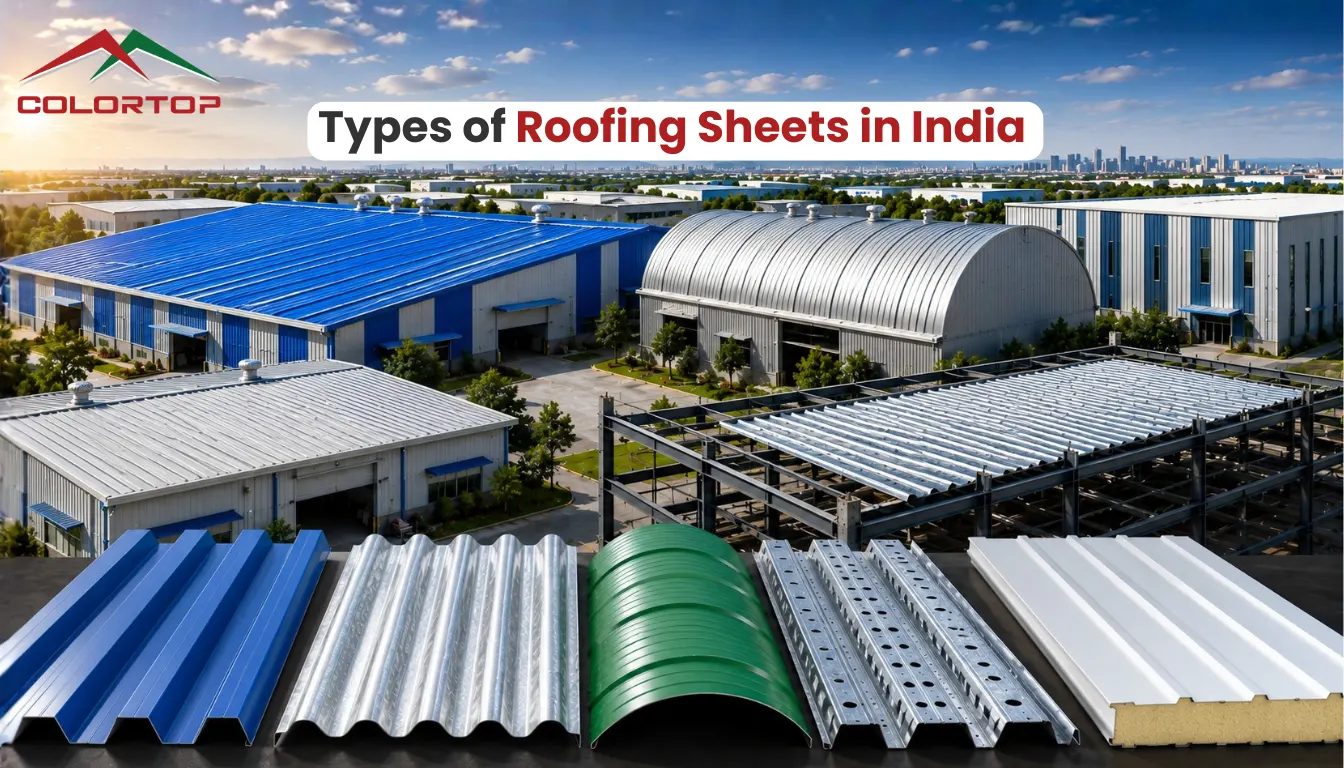
Modern PEB setups design the frame and the roof sheets to work together as a single, locked system. When you work with an integrated steel roofing shed manufacturer, your main frame, side purlins, and outer cladding are made for each other. Using the best metal roofing sheets in India, which feature precision-profiled, high-tensile, colour-coated steel, gives you an absolute weatherproof seal. The panels lock tight, keep the rain out, and help keep internal temperatures steady.
Breaking Down the Costs
Don’t make the mistake of just looking at the price per tonne of fabricated steel. To find the real numbers, you have to look at the entire lifecycle of the build.
- Foundation Savings: PEB frames weigh much less because of the smart design. Lighter frames mean less pressure on the ground, so you need less concrete and steel for your foundations. That saves you big money right at the start.
- Zero Waste: Factory production cuts out raw material waste. Your project budget stays safe from sudden steel price hikes that happen during long, drawn-out field builds.
- Low Maintenance: Factory finishes and precision-fitted colour sheets stop rust before it can start. You won’t be spending your weekends managing repair crews.
The Verdict
Look, conventional steel fabrication still makes sense if you are building an incredibly odd, irregular architectural shape or if you just want to make quick, ad hoc changes right on the field.
But for modern industrial applications, where you need clear open spans, rapid completion, predictable costs, and factory-tested quality, pre-engineered buildings win hands down.
Partnering with Vishal Colour Roofs Limited brings over 25 years of manufacturing expertise and optimized structural systems straight to your project site.
FAQs
Q1: Why is a PEB shed cheaper than a conventional steel structure?
Ans: It cuts out wasted material. A PEB uses custom profiles that are thick only where the stress is high, making the frame much lighter. This lighter weight slashes your foundation, concrete, and steel costs. Plus, buying directly from a factory-scale steel structure manufacturer in India cuts down on expensive on-site fabrication labour.
Q2: Can I put standard roofing sheets on a conventional frame?
Ans: You can, but it risks leaks. Hand-welded frames always have slight human errors and misalignments. When you force sheets onto an uneven frame, tiny gaps form. It is much safer to work with an integrated steel roofing shed manufacturer who supplies the best metal roofing sheets in India, engineered to fit the frame perfectly from day one.
Q3: Exactly how much time does a PEB shed save?
Ans: You save up to 40% of your total construction time. Instead of waiting for foundations to cure before fabricating steel, a PEB allows workflows to run at the same time. The factory manufactures your entire kit while your site team digs the ground. Once it arrives, workers just bolt it together like a puzzle.
Q4: Can we expand a PEB shed later if our business grows?
Ans: Yes, very easily. Because PEB structures are modular and bolted together rather than permanently welded, expanding them is straightforward. A top steel structure manufacturer in India can design your building with future expansion in mind, letting you unbolt the end walls and add new bays whenever you need more space.