Roofing sheets are widely used for warehouses, factories, industrial sheds, commercial buildings and pre-engineered structures because they provide a practical combination of strength, lightweight construction and large-area roof coverage. But before selecting a roofing system, one question is particularly important: how long do roofing sheets last?
There is no single lifespan that applies to every roofing sheet. Metal roofing systems can remain functional for several decades when the material, coating, installation and environment are appropriate. As a broad industry reference, some metal-roof manufacturers cite approximately 40–70 years for properly installed systems, while research by the Metal Construction Association on specific 55% aluminium-zinc coated standing-seam systems projected service lives of 60 years or more under the conditions studied. These figures should not be treated as guarantees for every roofing sheet or building.
The actual service life of metal roofing sheets in India depends on the base metal, coating system, site environment, roof design, installation quality and exposure conditions.
This guide explains what affects roofing-sheet lifespan, how different types of metal roofing sheets perform, and what building owners should consider when choosing a long-lasting roofing solution.
What Is the Average Lifespan of Roofing Sheets?
Metal roofing is generally considered a long-service-life roofing system, but its actual lifespan varies significantly from one project to another.
A properly specified roof used in a suitable environment may remain in service for decades. However, that does not mean every roofing sheet will automatically last for the same number of years.
The most important factors include:
- Base steel quality
- Metallic and paint coating
- Environmental exposure
- Sheet profile and thickness
- Installation quality
- Fasteners and accessories
- Roof slope and drainage
- Building use and operating conditions
The type of coating is particularly important. Aluminium-zinc coated steel, for example, is specifically designed to improve corrosion resistance. Tata Steel Colors describes ZINCALUME® as an Al-Zn alloy-coated steel in which aluminium provides barrier protection and zinc provides sacrificial protection to the underlying steel.
Roofing Sheet Lifespan at a Glance
| Roofing Sheet Type | General Lifespan Consideration | Main Factors Affecting Performance |
|---|---|---|
| Colour Coated Roofing Sheets | Can provide long-term service when the coating system remains intact | Paint system, metallic coating, environment, installation |
| Galvanized Roofing Sheets | Service life varies with zinc coating and exposure | Zinc coating, humidity, pollutants, cut edges |
| Galvalume Roofing Sheets | Designed for enhanced corrosion resistance | Al-Zn coating, environment, installation |
| Corrugated Metal Roofing Sheets | Profile alone does not determine life | Base material, coating, fasteners, support system |
| Crimp Curved Roofing Sheets | Performance generally follows the parent coated sheet | Base sheet, coating, forming and installation quality |
Instead of asking only which product has the longest advertised lifespan, buyers should consider which roofing system best suits the actual project conditions.
What Factors Affect Roofing Sheet Lifespan?
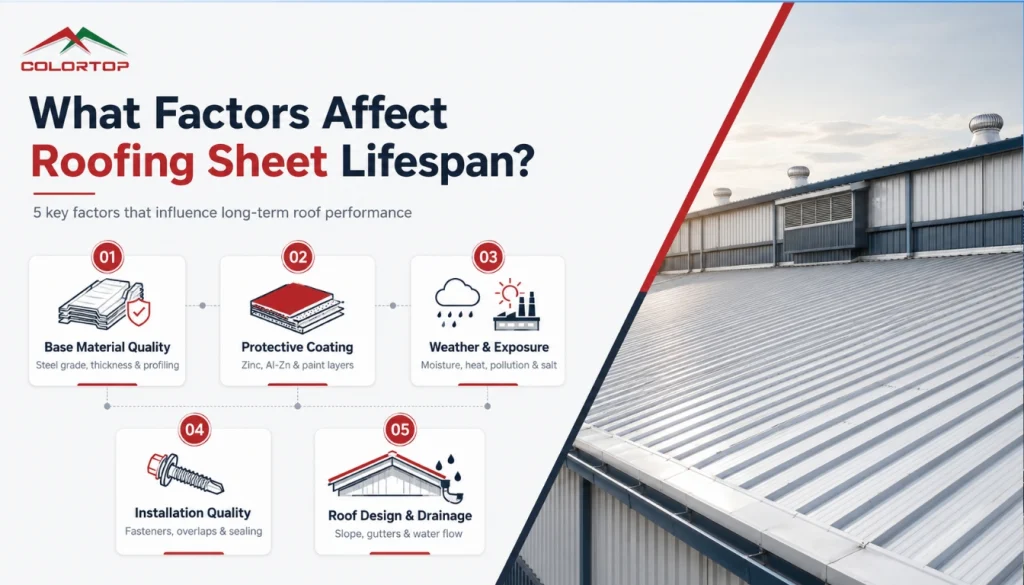
Several factors work together to determine how long a roof performs effectively.
1. Base Material Quality
A roofing sheet begins with the quality of its base material.
Material consistency, appropriate thickness and accurate profiling help a roofing system perform according to its intended design. Poor-quality or incorrectly specified material can create problems regardless of the coating applied to it.
When comparing a Roofing Sheets Manufacturer or different roofing sheets manufacturers in India, project owners should therefore evaluate material specifications and manufacturing capability rather than comparing only the final price.
2. Protective Coating
The coating system is one of the biggest influences on the durability of steel roofing.
Different products may use zinc, aluminium-zinc alloy or a combination of metallic and paint coatings. These layers help separate the underlying steel from moisture and environmental contaminants.
A color coated roofing sheet usually combines a coated steel substrate with additional paint layers to provide both weather protection and appearance.
Likewise, colour coated metal roofing sheets can be used where a finished architectural appearance is required alongside corrosion protection.
For aluminium-zinc systems, industry data indicates improved corrosion resistance compared with conventional galvanized coatings in comparable environments, although actual performance still depends heavily on the application.
3. Weather and Environmental Exposure
The same roofing sheet can perform differently in different locations.
Environmental factors include:
- Rain and prolonged moisture
- High humidity
- Temperature changes
- Industrial emissions
- Airborne chemicals
- Dust accumulation
- Salt exposure near coastal areas
Coastal and high-humidity environments, for example, place greater importance on corrosion-resistant coating selection. Zinc-aluminium coated roofing systems are commonly promoted for such environments because of their improved corrosion protection.
An industrial building exposed to fumes or chemicals may also require a different roofing specification from a conventional warehouse.
4. Installation Quality
Even high-quality roofing material can underperform when it is installed incorrectly.
Potential installation issues include:
- Incorrect overlaps
- Improper fastener placement
- Excessively tightened fasteners
- Loose fasteners
- Coating damage during installation
- Incorrect flashing details
- Poor sealing around penetrations
- Improper cutting or handling
Installation should follow the project’s structural and roofing requirements.
5. Roof Design and Drainage
A roofing system should allow rainwater to drain efficiently.
Poor roof slopes, obstructed gutters or locations where water repeatedly collects may increase moisture exposure.
Roof design should therefore coordinate roofing sheets with flashings, gutters, downpipes, ridge details and other drainage components.
Lifespan of Different Types of Roofing Sheets
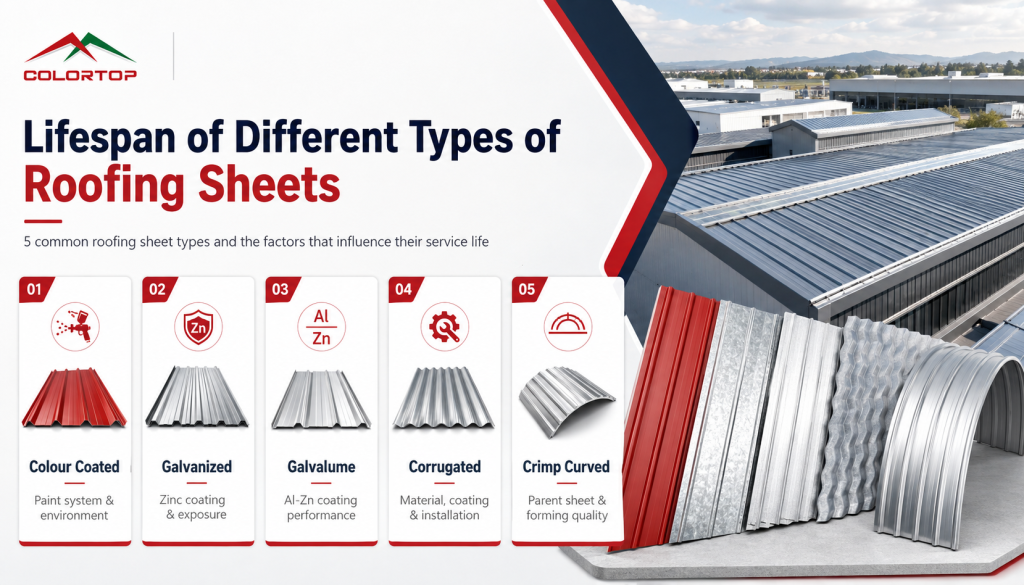
Different sheet types use different materials, coatings and profiles. Understanding those differences makes it easier to select the right roofing solution.
Colour Coated Roofing Sheets
Colour-coated sheets are widely used in warehouses, factories, industrial sheds and commercial structures.
A typical roofing colour sheet consists of a steel substrate with protective metallic and paint coatings. The coating provides the visible finish while helping protect the base metal.
The performance of a color coated roofing sheet depends on:
- Coating specification
- Base steel
- Paint system
- Environmental exposure
- Installation
- Handling during construction
Damage to the protective coating can expose the substrate, which is why correct transportation, cutting and installation are important.
Galvanized Roofing Sheets
Galvanized steel is protected by a zinc coating.
Zinc provides sacrificial protection to the underlying steel. The durability of galvanized roofing therefore depends partly on the amount and condition of the zinc coating and on the environment in which the sheet is installed.
Scratches, cut edges, standing moisture and aggressive atmospheric conditions can affect long-term performance.
Galvalume Roofing Sheets
Galvalume roofing sheets use an aluminium-zinc alloy coating rather than a conventional zinc-only coating.
A commonly used 55% Al-Zn coating contains approximately 55% aluminium, 43.5% zinc and 1.5% silicon. This combination is designed to combine aluminium’s barrier protection with zinc’s sacrificial protection.
Research on certain 55% Al-Zn standing-seam roof systems has demonstrated particularly long projected service life, although those findings relate to specific coating weights, profiles and exposure conditions and should not be applied as a guaranteed lifespan for every galvalume roof.
Corrugated Metal Roofing Sheets
Corrugated roofing sheets have a repetitive wave-shaped profile that improves stiffness.
However, corrugation itself is not a coating or material. Therefore, the expected life of corrugated metal roofing sheets in India depends largely on the steel substrate, metallic coating, paint system, installation and environmental conditions.
When selecting corrugated roofing, consider:
- Base metal
- Thickness
- Coating
- Profile geometry
- Purlin spacing
- Fasteners
- Site environment
Crimp Curved Roofing Sheets
Crimp curved roofing sheets are formed into curved shapes for applications such as canopies, curved roofs, entrances and architectural roofing sections.
Their service life is influenced primarily by the parent sheet and coating, along with the quality of the crimping and installation process.
Forming should be properly controlled so that the sheet geometry is achieved without unnecessary coating damage.
Which Roofing Sheets Last Longer?
There is no single product that can accurately be called the longest-lasting roofing sheet for every building.
The best roofing sheets in India for a dry inland warehouse may differ from the best choice for a humid factory, coastal facility or building exposed to industrial contaminants.
Similarly, the best metal roofing sheets in India should be selected based on project requirements rather than only on brand, colour or initial purchase price.
Consider:
- Site environment
- Building application
- Coating system
- Structural requirements
- Roofing profile
- Drainage
- Installation method
- Expected operating conditions
The correct combination of these factors is usually more important than simply choosing one material because it is advertised as having a longer lifespan.
Signs Roofing Sheets May Be Reaching the End of Their Service Life
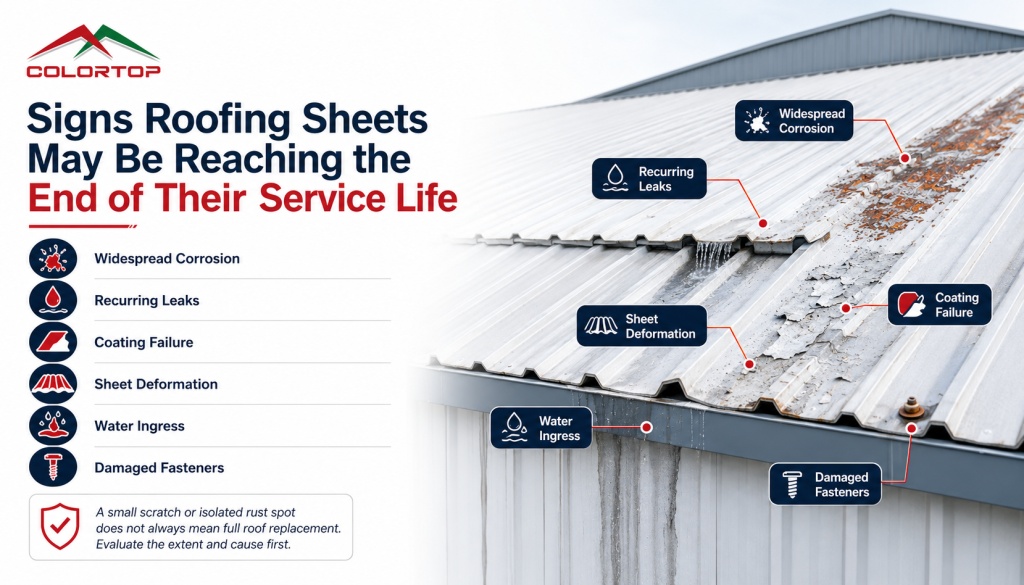
Roof deterioration does not always mean that complete replacement is immediately necessary.
Some issues can be localized, while others indicate broader deterioration.
Common Warning Signs
- Widespread corrosion
- Recurring leaks in multiple areas
- Extensive coating failure
- Severe sheet deformation
- Persistent water ingress
- Multiple damaged or corroded fasteners
- Repeated problems even after localized repairs
A small scratch or isolated rust spot does not automatically mean the entire roofing system has reached the end of its life.
The extent and cause of deterioration should first be evaluated.
Maintenance or Replacement?
| Roof Condition | Local Repair/Inspection May Be Appropriate | Wider Replacement May Need Evaluation |
|---|---|---|
| Minor coating scratch | Yes | Usually no |
| Isolated loose fastener | Yes | Usually no |
| Single local leak | Often | Depends on cause |
| Small localized corrosion | Often | Depends on severity |
| Widespread corrosion | Limited benefit | Yes |
| Severe sheet deformation | Sometimes | Often |
| Multiple recurring leaks | Investigation required | May be necessary |
| Extensive coating breakdown | Limited | May be necessary |
This distinction is important because replacing an entire roof for a small localized issue can be unnecessary, while repeatedly repairing a severely deteriorated roof may also be inefficient.
Can the Lifespan of Roofing Sheets Be Extended?
Proper care can help roofing sheets continue performing effectively.
Basic measures include periodic inspection, keeping drainage routes clear, addressing local coating damage, checking fasteners and preventing persistent water accumulation.
Roof access should also be controlled to avoid unnecessary physical damage to sheets and coatings.
However, detailed maintenance procedures are a separate subject. A dedicated roofing sheet maintenance guide can explain inspection intervals, cleaning, repairs, fasteners, sealants and preventive care in greater detail.
How to Choose Long-Lasting Roofing Sheets
Long roof life starts with correct product selection.
Select According to the Building
Warehouses, factories, workshops, industrial sheds and commercial structures may require different roofing specifications.
Match the Coating to the Environment
The coating system should reflect local moisture, pollution, humidity and corrosion exposure.
Select an Appropriate Thickness
Thickness should be based on roof design, profile, support spacing and structural requirements.
A thicker sheet is not automatically better if the complete roofing system has not been correctly engineered.
Review the Roofing Profile
Profile geometry affects stiffness, drainage, appearance and compatibility with the supporting structure.
Evaluate Manufacturing Quality
When comparing roofing sheets manufacturers in India, consider:
- Material specifications
- Manufacturing consistency
- Profiling accuracy
- Coating options
- Quality control
- Project experience
- Ability to manufacture according to project requirements
Likewise, users comparing roofing sheets manufacturers in Delhi should consider technical capability and product suitability alongside proximity and delivery convenience.
Consider the Complete Roofing System
Roofing sheets do not work independently.
Fasteners, flashings, sealants, gutters, ridges, structural supports and installation workmanship all influence overall roof performance.
Related Article
What is a Pre-Engineered Building? Complete Guide
Top 10 PEB Manufacturers in India (2026)
Types of Roofing Sheets in India: Complete Guide for Industrial & Commercial Buildings
PEB Buildings vs RCC Structures: Which Is Better for Industrial Projects in 2026?
How to Install Roofing Sheets: Step-by-Step Guide & Expert Tips
Frequently Asked Questions
How long do metal roofing sheets last?
Metal roofing sheets can remain in service for several decades when properly specified and installed. Some manufacturers cite approximately 40–70 years for metal roofs, while actual service life varies significantly with material, coating, environment and roof system.
Which roofing sheet has the longest lifespan?
There is no universal winner. Aluminium-zinc coated steel offers strong corrosion resistance, but the most suitable sheet depends on the building environment, coating specification and installation conditions.
Do colour coated roofing sheets last longer?
Protective coatings can help reduce exposure of the base metal to moisture and contaminants. Actual lifespan still depends on coating specification, installation and environment.
Does climate affect roofing sheet lifespan?
Yes. Humidity, rainfall, coastal salt exposure and industrial pollutants can influence corrosion and coating performance.
Are galvalume roofing sheets durable?
Aluminium-zinc coated steel is designed for enhanced corrosion resistance and long-term roofing and cladding applications. Actual durability depends on the specific product and exposure conditions.
When should roofing sheets be replaced?
Replacement should be evaluated when deterioration becomes widespread—for example, extensive corrosion, recurring leaks, major deformation or broad coating failure—rather than because of a single localized defect.
Conclusion
So, how long do roofing sheets last? In many cases, metal roofing can provide several decades of service, but there is no single lifespan that applies to every product or project. Material quality, protective coating, environmental exposure, roof design and installation all influence actual performance.
Colour-coated, galvanized, galvalume, corrugated and crimp curved roofing sheets can all provide effective long-term roofing when correctly matched to the building and environmental conditions.
Instead of choosing only on initial cost, buyers should evaluate material specifications, coating systems and project suitability.
For industrial and commercial roofing projects, Vishal Colour Roofs Limited provides roofing solutions for warehouses, factories, industrial sheds and other large building applications.